338-Page Core System
The full Ghostwriter Protocol Method for planning, drafting, revising, and controlling AI-assisted books.
Built for AI authors and indie authors who already use AI to write, but still struggle with generic prose, messy chapters, weak structure, style drift, and long-form inconsistency.
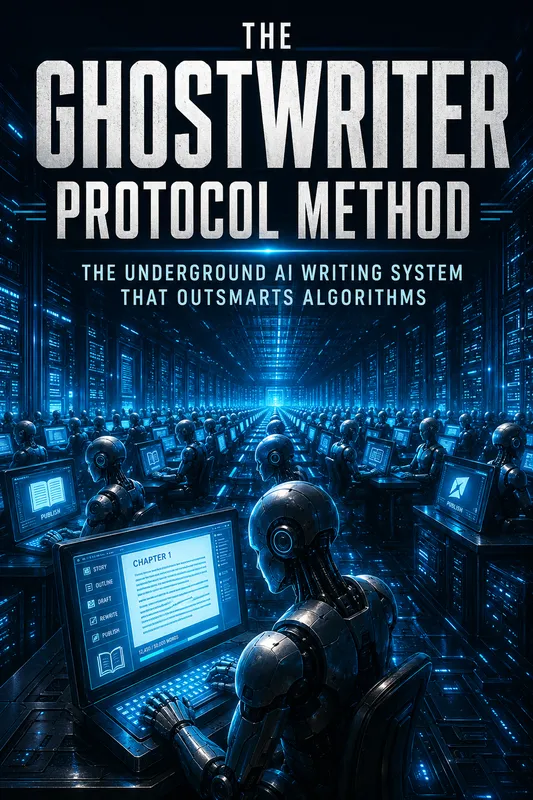
For AI authors, indie authors, and self-publishers. Launch offer: $149.99 lifetime access. Use discount code 30OFF at checkout.
Get lifetime access today for $149.99 (Before Discount). Copy the code, use it at checkout, and claim the current launch discount before the timer ends.
You are not buying a simple prompt ebook. You are getting a complete AI writing and publishing system.
The full Ghostwriter Protocol Method for planning, drafting, revising, and controlling AI-assisted books.
A complete bonus library covering fiction, nonfiction, prompts, style, dialogue, ghostwriting, and AI book cover business ideas.
Extra training material to help you create manuscripts, digital products, services, and reusable workflows.
Use the system for novels, short stories, nonfiction guides, self-help books, educational ebooks, and publishing projects.
Turn the method into prompt products, ghostwriting services, book outline offers, AI writing kits, and cover concept services.
Use it again and again for every new book, product, or client project.
You are not just getting another prompt ebook. You are getting a complete AI book-writing system, plus author-focused bonuses.
This is the core system of the entire package. It teaches the complete AI book-building workflow: idea development, premise control, book structure, chapter planning, scene or section beats, drafting, revision, and long-form manuscript control.
Instead of asking AI for random chapters, this system helps you direct the entire writing process with structure.
This part helps you use AI for fiction projects with more control and consistency. It supports story premises, character arcs, emotional beats, worldbuilding, scene development, dialogue, pacing, and genre-aware storytelling.
It is designed for writers who want AI to help build actual stories, not just produce generic scenes.
This system helps you create practical, reader-focused nonfiction books and guides. It covers chapter promises, teaching flow, examples, frameworks, action steps, transformation logic, and reader outcomes.
It is useful for self-help books, educational ebooks, business guides, how-to books, and authority-building content.
This teaches you how to make AI improve its own work through layered prompting, self-review, diagnosis, rewriting, refinement, and quality-control loops.
Instead of accepting the first draft, you learn how to make AI question, improve, restructure, and strengthen the output step by step.
One of the biggest problems with AI writing is inconsistency. Characters change, tone drifts, chapters repeat themselves, logic breaks, and earlier details get forgotten.
This system is designed to help you control continuity, voice, structure, recurring ideas, character behavior, chapter logic, and long-form consistency across a full manuscript.
This framework helps you think beyond one book. It shows how the Ghostwriter Protocol can be reused across multiple manuscripts, book series, niche ebook collections, publishing assets, and repeatable content systems.
This is where the package becomes more than a writing guide. It becomes a reusable production framework.
This section connects the writing system to business opportunities. It helps you see how the method can support ghostwriting services, book outline services, prompt products, AI writing kits, nonfiction ebook products, publishing workflows, and author-focused service offers.
It is especially valuable for people who want to use AI writing not only to create books, but also to create sellable digital products or services.
The package also includes 9 bonus training systems with 760 total pages. These bonuses expand the core method into specific use cases such as nonfiction writing, fiction premises, prompt templates, writing style, dialogue improvement, ghostwriting, AI book covers, and AI cover design business ideas.
Instead of giving you only one main ebook, the package gives you an entire support library for applying the system in different writing, publishing, and business directions.
The method is not tied to one AI model, one platform, or one temporary trick.
As AI tools become stronger, the Ghostwriter Protocol becomes easier to apply because the value is not in one specific prompt. The value is in the thinking structure: how you guide, control, revise, and direct AI toward a better book or publishing asset.
That makes the system reusable even as ChatGPT, Claude, Gemini, and future AI tools continue to improve.
Launch offer today:
Use code 30OFF at checkout before the timer ends.
338-page main system. 760 pages of bonus books. Real-world demo walkthrough. Immediate lifetime access.
At first, I believed AI could take the story in my head and turn it into a complete book with one perfect prompt.
I thought I could press one button and get a 50,000-word manuscript.
But I was wrong.
Even after 2,000 words, the writing started to fall apart.
The first chapter looked impressive. Then the next chapter changed tone. The ideas repeated. The structure became loose. The characters forgot who they were. The manuscript no longer felt like a book.
It felt like disconnected AI answers.That was when I realized the problem was not AI.
The problem was how I was using AI.
I was treating it like a magic machine, when I should have treated it like a ghostwriter — someone who needs a clear brief, structure, direction, revision, and quality control.
A book cannot be built with random prompts alone.
It needs premise, outline, chapter logic, continuity, memory, and a repeatable writing process.
Then I asked myself:
Why should I struggle to create every prompt manually?If AI understands the goal, why not let AI help build the prompts it needs to write better?
That idea became the Ghostwriter Protocol Method.
Not a one-click miracle. A system for directing AI properly, so it can help you build a real book instead of disconnected chapters.
The Ghostwriter Protocol Method is built for authors who already know AI can write but want to stop fighting generic prose, broken chapters, style drift, shallow scenes, and messy long-form drafts.
Thinking, outlining, worldbuilding, dialogue, structure, revision, and production planning while you guide the direction.
Build fiction, nonfiction, and multi-book concepts without constantly fighting plot holes, style drift, or weak structure.
Turn style, genre tone, and narrative preferences into reusable writing rules AI can follow across long-form projects.
Make AI generate prompts, refine instructions, challenge weak ideas, and improve its own output through revision loops.
Go beyond writing with AI-assisted book covers, product ideas, prompt templates, and publishing business workflows.
The better AI models become, the more powerful this system becomes because it is model-independent, not prompt-dependent.
Most AI authors are not failing because AI cannot write. They are failing because they keep asking AI to generate chapters without a real structure, revision loop, style system, or continuity plan.
Most AI-written books fail because the author asks AI to write too early.
They jump straight into:
And then they wonder why the result feels generic, messy, inconsistent, or impossible to finish.
The Ghostwriter Protocol changes the process.
Instead of asking AI to write a book and hoping for the best, you guide it through a controlled sequence: idea, premise, structure, beats, draft, and revision.
That means AI is not guessing the book. AI is following the system.
This step helps you turn a vague concept into a clearer book foundation: what the book is about, who it is for, what kind of experience it should create, and what the final result should feel like.
Instead of starting with a blurry idea, you start with a defined creative target.
This step helps you build a stronger hook, clearer conflict, sharper angle, stronger promise, and better reason for the book to exist.
For fiction, this means a premise with tension, character direction, and story engine. For nonfiction, this means a clear reader problem, transformation promise, and teaching angle.
This step helps you create the book’s structure before drafting: chapter flow, section logic, reader journey, story movement, argument sequence, or teaching framework.
Each chapter gets a purpose. Each section has a reason to exist. The book becomes easier to follow, expand, and finish.
Before generating full chapters, you create smaller building blocks: scene beats, chapter points, emotional shifts, key ideas, examples, conflicts, reveals, transitions, and ending hooks.
This prevents AI from rushing, rambling, or filling pages with generic text.
But the Protocol does not stop at first draft.
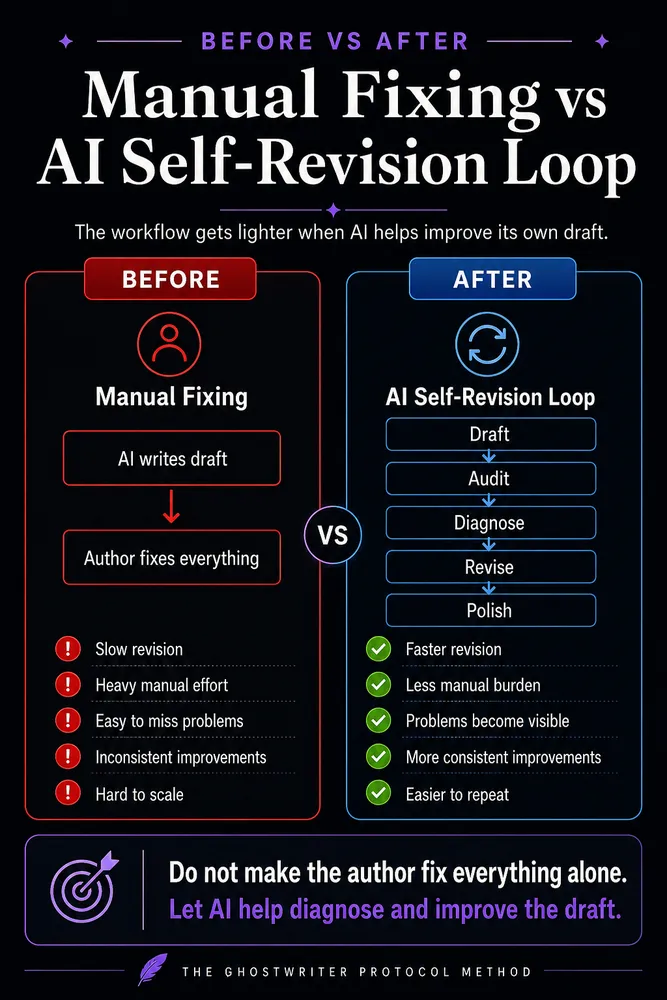
You also use AI to audit, diagnose, revise, and polish the manuscript. AI can help identify weak structure, repetitive sections, inconsistent voice, shallow scenes, missing logic, and unclear transitions.
Instead of manually fixing everything alone, you make AI part of the revision process.
Because a book is not just text. A real book needs:
That is why one random prompt is not enough.
The Ghostwriter Protocol gives AI a path to follow.
AI guesses what to write.You get disconnected chapters.
You manually fix everything.The draft becomes harder to control as it grows.
AI follows a controlled book-building system.Each chapter has a purpose.
AI helps diagnose and improve the draft.The manuscript becomes cleaner and easier to finish.
You do not need AI to write faster random text.
You need AI to help you build a better book.
The Ghostwriter Protocol gives you a repeatable process for turning AI from a prompt machine into a serious long-form writing partner.
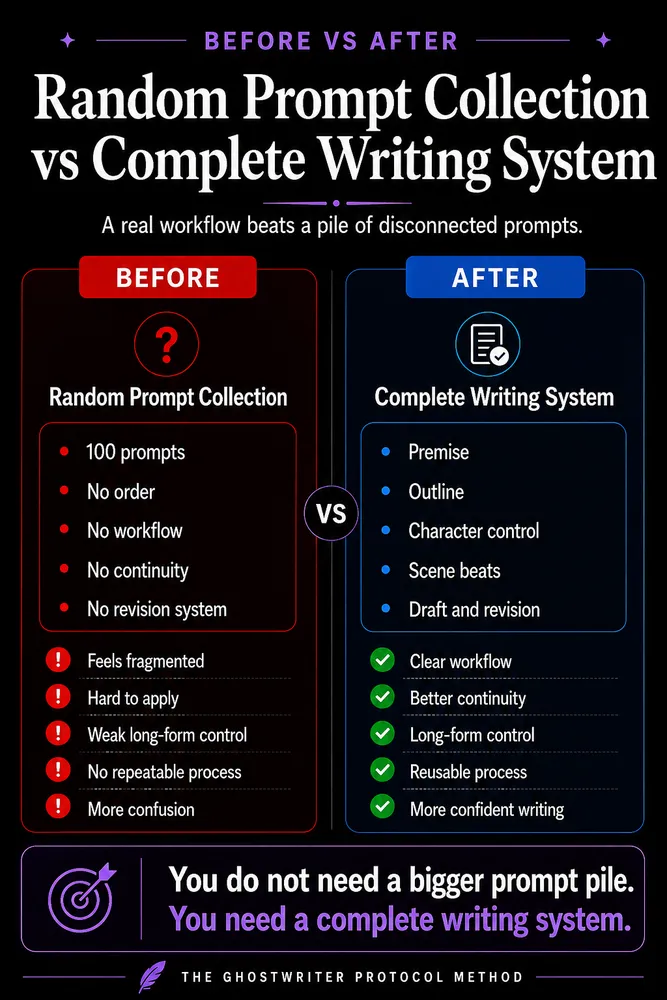
Most AI writing products give you a list of prompts. They say:
But a book is not built from disconnected prompts.
A real book needs structure, continuity, voice, pacing, revision, and a clear process from idea to finished manuscript.
That is the difference.
The Ghostwriter Protocol Method is not a static prompt collection. It is a complete AI book production system designed to help you plan, guide, draft, revise, and improve long-form writing with AI.
You are not just asking AI for text. You are giving AI a system to follow.
Generic AI prompt books can be useful for small tasks, but they often break down when you try to use them for a full book.
They usually give you prompt templates like:
These can help for one-off outputs. But when you are writing a real book, the problems start appearing.
One prompt creates an outline. Another prompt creates a character. Another prompt writes a chapter. Another prompt rewrites a scene. But they do not work together as one complete system. The result? Your book feels like a collection of AI outputs, not one unified manuscript.
Generic prompts may work for a short article, a chapter sample, or a quick scene. But once the project becomes long-form, problems appear: Chapter 1 sounds strong, Chapter 3 starts repeating itself, Chapter 5 forgets earlier details, Chapter 7 changes tone, and Chapter 10 feels like a different book.
That is because a longer book needs memory, structure, continuity, and revision logic — not just prompts.
If thousands of people use similar prompts, the output often starts to feel similar: too polished but empty, emotionally flat, overly generic, repetitive, predictable, full of common AI phrases, and lacking a distinct author voice.
The book may be readable, but it does not feel memorable.
Generic prompts often generate messy output, then leave you alone to repair it. You have to check whether the chapter matches the outline, whether the character changed personality, whether the voice is consistent, whether sections repeat, and whether the chapter actually moves the book forward.
So even though AI writes fast, you still become the person cleaning up the chaos.
Most prompt books focus on generation. But serious book writing needs revision. You need a way to make AI audit the chapter, find weak structure, identify repetition, check continuity, improve pacing, strengthen transitions, refine the voice, and compare the draft against the original plan.
Without that, you get first drafts — not finished manuscripts.
A prompt book usually teaches you what to type. But it does not teach you how to think through the book: the book’s core promise, what each chapter should accomplish, where tension should increase, where the argument should deepen, and what AI should remember before writing the next section.
That is why prompt collections often feel useful at first, but limited later.
The Ghostwriter Protocol Method is built differently.
It does not start with: “Here are 100 prompts. Good luck.†It starts with a process.
A repeatable way to guide AI from rough idea to structured manuscript.
Instead of treating AI like a text generator, you treat AI like a ghostwriter that needs direction, briefing, structure, revision notes, and quality control.
The Protocol guides AI through stages: idea, premise, structure, character or reader journey, chapter map, scene beats or teaching points, drafting, revision, polishing, and final assembly.
Instead of asking AI to “write a book,†you guide it through a book-building process.
Most people ask AI to write too early. The Protocol helps you build the foundation first.
For fiction, that means premise, character motivation, conflict, world rules, emotional arc, scene purpose, chapter direction, and continuity notes.
For nonfiction, that means reader problem, transformation promise, chapter thesis, teaching framework, examples, action steps, argument flow, and practical application.
By the time AI writes, it already has a map.
A weak AI book often feels like random chapters placed together. The Protocol makes each chapter answer: What is this chapter supposed to do? What changes by the end of it? What should the reader understand? What should the character decide? What conflict should move forward? What should connect this chapter to the next one?
That makes the book feel more intentional.
The Protocol is designed for long-form control. AI is guided to remember previous chapter events, character behavior, tone rules, world logic, nonfiction argument flow, reader journey, important decisions, unresolved questions, and future setup.
This helps reduce one of the biggest problems in AI writing: inconsistency.
For fiction, the Protocol can help with stronger premises, character arcs, plot movement, scene beats, dialogue improvement, worldbuilding, tension, pacing, and continuity.
For nonfiction, it can help with clear frameworks, better explanations, chapter logic, reduced repetition, reader transformation, examples, teaching flow, and practical action steps.
The Protocol does not only help AI write. It also helps AI review what it wrote. You can use AI to check weak chapter structure, repetitive sections, style drift, unclear transitions, shallow explanations, inconsistent character behavior, weak dialogue, pacing problems, missing tension, and lack of reader value.
AI becomes part of the improvement process, not just the drafting process.
A prompt collection gives you scattered tools. The Protocol gives you a reusable workflow. You can use it for one book, a book series, fiction, nonfiction, short ebooks, long manuscripts, client ghostwriting, KDP publishing, digital products, and author service offers.
The value is not just in one output. The value is in having a repeatable system.
Give you static prompt templates.
Teaches you how to build a book with AI step by step.
Help you generate isolated pieces of text.
Helps you connect idea, premise, structure, beats, draft, and revision.
Can break down when the book gets longer.
Is designed for long-form writing control.
Often make the writing sound generic.
Helps guide AI with style rules, voice direction, and genre expectations.
Leave you to manually fix inconsistencies.
Uses AI-assisted revision loops to audit, diagnose, and improve the draft.
Focus on what to type into AI.
Focuses on how to direct AI through a complete book-building process.
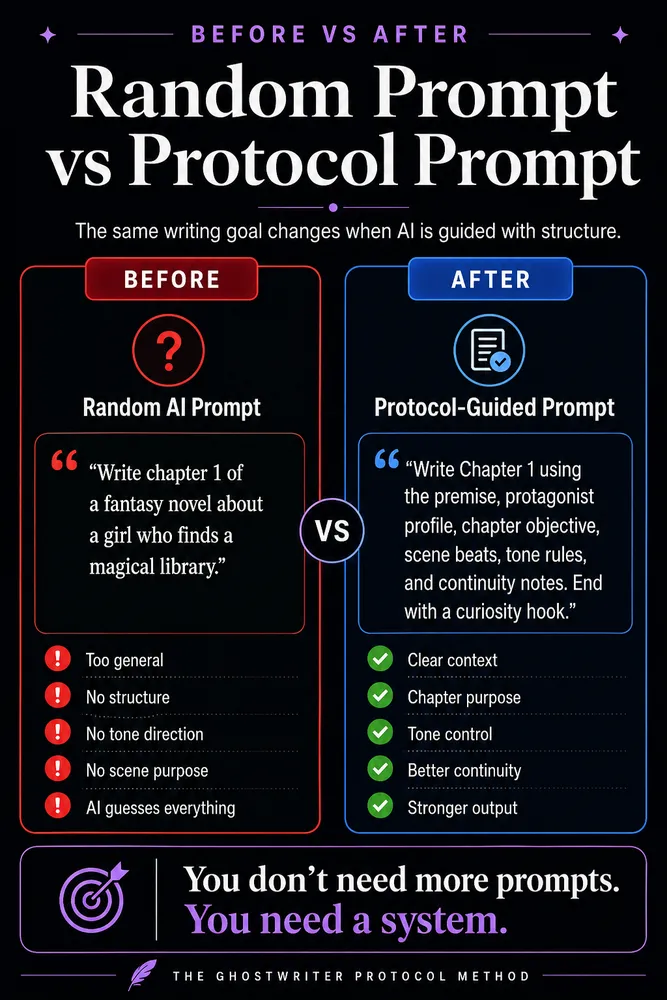
With a Generic Prompt Book: You might use “Write Chapter 3 of a fantasy novel in a dramatic style.†AI may produce a decent chapter, but it may not know what happened in Chapter 2, what the protagonist wants, what conflict must increase, what clue should be planted, or what ending hook should create.
With The Ghostwriter Protocol Method: Before drafting Chapter 3, you guide AI with chapter objective, previous continuity notes, character motivation, emotional shift, key conflict, scene beats, tone rules, world logic, ending hook, and next chapter bridge.
Now AI is not just writing a chapter. It is writing a chapter with a purpose.
With a Generic Prompt Book: You might use “Write a chapter about productivity.†AI may produce generic definitions, obvious advice, repeated ideas, filler paragraphs, weak examples, and no clear transformation.
With The Ghostwriter Protocol Method: You guide AI with reader problem, chapter promise, key teaching framework, supporting examples, common mistakes, practical action steps, and transition to next chapter.
Now the chapter is not just “content.†It becomes part of a reader journey.
With a Generic Prompt Book: You might use “Make this dialogue more natural.†AI may improve the lines slightly, but it may not understand character personality, relationship tension, emotional subtext, scene purpose, hidden conflict, or what each character refuses to say directly.
With The Ghostwriter Protocol Method: You guide AI with character voice rules, relationship history, emotional agenda, subtext, conflict level, pacing notes, and what must change by the end of the scene.
Now dialogue becomes more than conversation. It becomes story movement.
If all you want is a few prompts, a prompt book may be enough.
But if you want to write better books with AI, you need more than prompts.
You need a system for planning, structuring, drafting, revising, maintaining consistency, improving weak output, and repeating the process.
That is what The Ghostwriter Protocol Method is built to give you.
It is not another list of things to type into AI. It is a complete method for turning AI into a serious long-form writing partner.
The Ghostwriter Protocol Method is built for writers who already know AI can write — but want more control, structure, and quality from the process.
This is not for people looking for a magic “one-click book†shortcut.
This is for authors who want to use AI more seriously: to plan better, write cleaner chapters, maintain consistency, and turn messy AI output into a stronger manuscript.
You already use ChatGPT, Claude, Gemini, or other AI tools — but you want better results than generic paragraphs and disconnected chapters.
You write fiction, nonfiction, short ebooks, KDP books, or full-length manuscripts and want a repeatable workflow for book creation.
Your AI drafts may sound repetitive, shallow, inconsistent, or hard to finish — and you want a better way to guide the process.
You want stronger outlines, cleaner chapter flow, better scene beats, consistent voice, and fewer problems when the book gets longer.
You do not want AI to randomly generate text. You want AI to help you think, plan, draft, revise, and improve.
This is not for anyone expecting AI to instantly create a perfect book without planning, direction, review, or editing.
If you have never used AI writing tools before, this may feel too advanced as a first step.
If you only want another list of copy-paste prompts, this is not that.
This system works best when you are willing to guide, review, improve, and make creative decisions.
The Protocol helps AI become more useful — but you are still the author, editor, and final decision-maker.
The main ebook is the core of the entire system.
Across 338 pages, The Ghostwriter Protocol Method shows you how to stop treating AI like a random prompt machine and start using it as a structured long-form writing partner.
It teaches the thinking, workflow, and execution behind AI-assisted book creation — from idea development to premise building, structure, drafting, revision, and final manuscript control.
This is the foundation before the bonuses.
This is the complete core system.
Inside, you learn how to guide AI through a controlled book-building process instead of asking it to generate disconnected chapters.
The goal is simple: better structure, stronger continuity, cleaner drafts, and a more repeatable way to write books with AI.
They jump straight into prompts like:
But without structure, AI often creates generic prose, repetitive chapters, inconsistent voice, weak pacing, and messy long-form drafts.
This part explains why one-shot prompting fails when you try to create a real book.
Instead of collecting more prompts, you learn how to direct AI through a system.
You’ll understand how to make AI help with planning, structuring, self-prompting, revision, and long-form development.
This is where the shift happens: AI stops being a text generator and starts becoming a guided writing partner.
You learn how to guide AI through the full book-building process:
This is the practical engine of the book.
It shows how to build fiction and nonfiction projects in a more controlled, repeatable way.
You’ll learn how to handle bigger and more complex AI writing problems, such as:
This part is designed to help you keep control when the project becomes longer, deeper, or more ambitious.
The 338-page main ebook gives you the complete foundation: understand the problem, learn the principles, apply the protocol, then fix and improve the output.
It is not just about writing faster with AI.
It is about writing with more control.
A practical framework for turning AI from a random text generator into a structured writing partner.
This is where you learn how to guide AI before, during, and after the writing process — so your book has a clearer idea, stronger structure, better voice, and a more controlled manuscript flow.
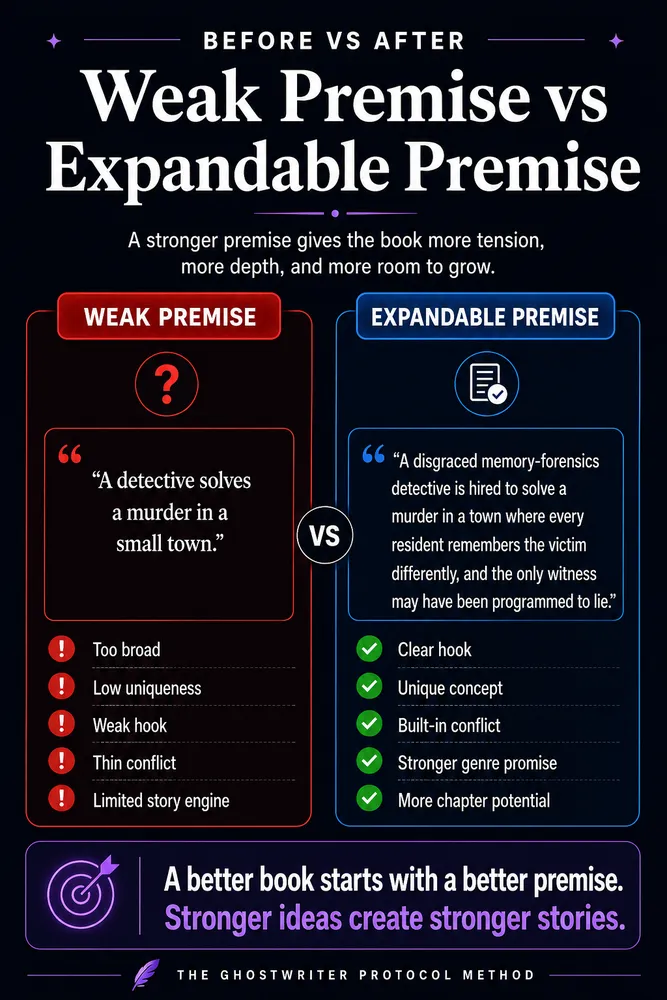
A weak premise makes the whole book harder to write.
You’ll learn how to develop book ideas with clearer angles, stronger hooks, better conflict, and more long-form potential.
Instead of asking AI for generic ideas, you guide it to build concepts that can actually support a full book.
AI can generate chapters quickly, but speed means nothing if the book has no structure.
You’ll learn how to create chapter lists, section logic, story flow, nonfiction frameworks, and reader journeys before drafting begins.
This gives AI a map to follow instead of letting it wander.
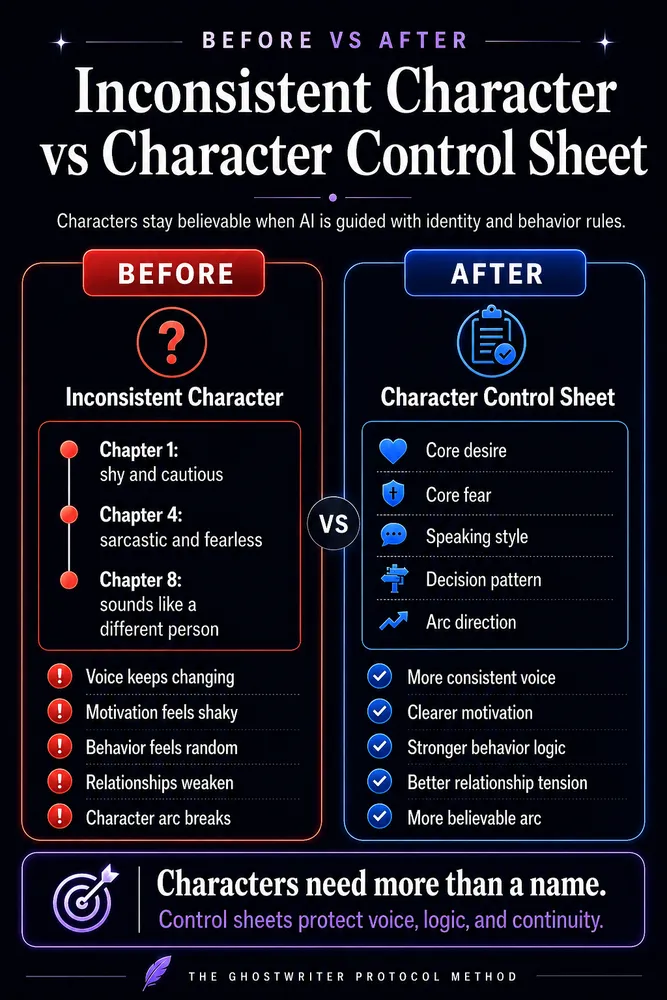
One common AI writing problem is inconsistency.
Characters change personality. The tone shifts. Dialogue starts sounding the same.
You’ll learn how to guide AI with character rules, voice direction, tone control, genre expectations, and continuity notes.
Before AI writes a full chapter, it needs smaller building blocks.
You’ll learn how to create scene beats, chapter points, emotional shifts, key conflicts, examples, transitions, and ending hooks.
This helps AI write with purpose instead of filling pages randomly.
The goal is not to create one good output by accident.
The goal is to build a repeatable process.
You’ll learn how to reuse the same system for different books, genres, chapters, series, nonfiction guides, and manuscript projects.
Once the workflow is clear, you can use it for more than one book.
You can apply the Protocol to book series, publishing workflows, ghostwriting services, prompt products, digital assets, or content systems.
This turns AI writing from a one-time experiment into a repeatable production method.
The core system is designed to help you control the parts of AI writing that usually become messy: structure, voice, continuity, revision, and long-form development.
It gives you a practical way to guide AI from raw idea to organized manuscript.
You’ll learn a step-by-step process where AI helps plan, write, review, revise, and improve the work.
Instead of generating random text once, AI becomes part of a recursive writing loop: create, check, refine, and improve.
You’ll learn how to make AI help create its own instructions.
Instead of always guessing the perfect prompt yourself, you guide AI to build better prompts, ask better questions, and improve its own execution logic.
This is one of the key differences between using AI casually and using AI as a writing system.
For fiction, consistency matters.
You’ll learn how to manage character motivation, emotional arcs, world rules, dialogue style, genre logic, relationship tension, and continuity.
This helps prevent the common problem where AI forgets what kind of story it is writing.
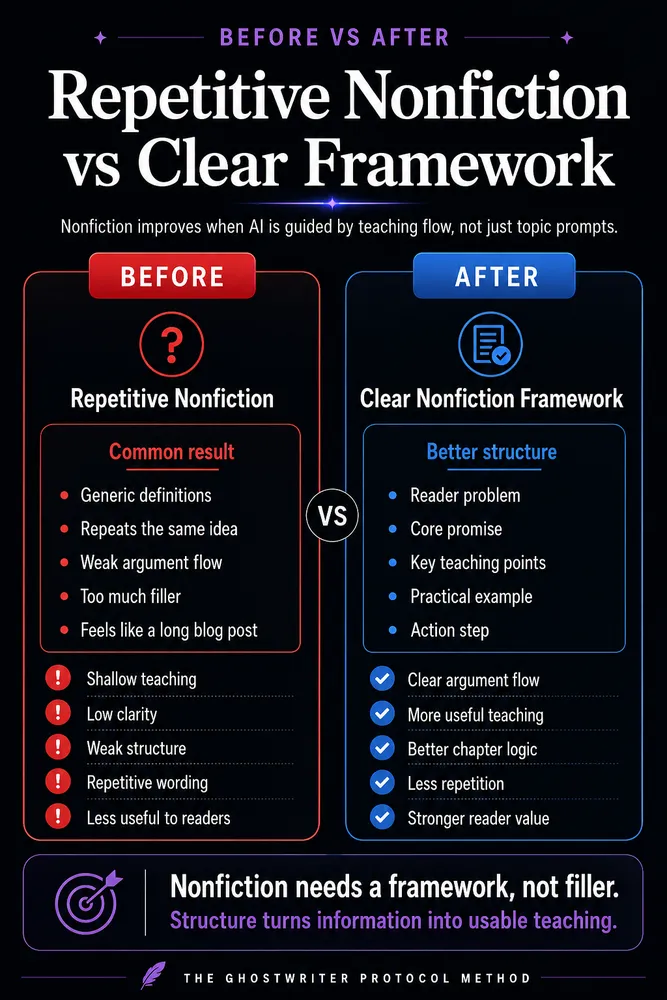
For nonfiction, the biggest problem is usually repetition, shallow explanation, and weak structure.
You’ll learn how to guide AI with reader problems, chapter promises, teaching frameworks, examples, credibility checks, and practical action steps.
This helps AI create useful nonfiction instead of long generic articles.
The Protocol does not stop after the first draft.
You’ll learn how to make AI audit its own work, detect weak structure, find repetition, check continuity, improve transitions, strengthen voice, and revise messy output.
This helps reduce the burden of manually fixing everything yourself.
Short AI content is easy. Books are different.
You’ll learn how to scale from outlines and short drafts into longer manuscripts, full books, and multi-book projects while keeping stronger continuity and structure.
The goal is long-form control, not just faster text generation.
The main ebook gives you the complete Ghostwriter Protocol Method. But the bonuses are not just “extra reading.â€
Each bonus is designed to help you turn the Protocol into practical output: nonfiction books, fiction ideas, prompt products, writing services, book covers, ghostwriting offers, and AI-powered publishing assets.
In total, you get 9 bonus books with 760 bonus pages — each one focused on a specific way to write, package, improve, or monetize AI-assisted book creation.
Most AI nonfiction becomes repetitive because people ask AI to “write about a topic†instead of building a clear teaching structure.
This bonus shows you how to apply the Ghostwriter Protocol to nonfiction books, authority guides, educational ebooks, and practical how-to content. You’ll learn how to guide AI with reader problems, chapter objectives, frameworks, examples, key teaching points, and action steps.
Example income opportunity:
If you create a simple nonfiction ebook using this bonus and sell it for $19, then:
Even one focused niche ebook can potentially recover the cost of this entire package.
Writing one book with AI is useful. Building a repeatable production pipeline is much more powerful.
This bonus helps you turn AI-assisted writing into a step-by-step workflow: idea generation, premise selection, outlining, drafting, revision, formatting, cover creation, and publishing preparation.
Instead of starting from zero every time, you build a repeatable system you can use for multiple books.
Example income opportunity:
If this pipeline helps you produce just 1 extra ebook per month, and each ebook earns only $100/month, then:
The value is not only in one book. The value is in building a repeatable production machine.
A weak book usually starts with a weak idea.
This bonus helps you generate stronger, more expandable premises before writing begins. Instead of asking AI for generic ideas, you learn how to develop concepts with stronger hooks, conflict, genre promise, reader curiosity, and long-form potential.
This is especially useful for fiction authors, series creators, romance writers, thriller writers, fantasy writers, and anyone who often gets stuck before Chapter 1.
Example income opportunity:
You could create a small digital product like “100 AI-Generated Romance Premises for Indie Authorsâ€. If sold for $9:
This bonus alone could become a product idea generator.
Most people collect prompts. This bonus shows how prompts can be packaged into products.
You’ll learn how to think about prompt templates as sellable digital assets: prompt packs, writing kits, niche workflow prompts, author tools, and AI-assisted creation systems.
This is useful if you want to create small digital products for writers, creators, coaches, teachers, authors, or business owners.
Example income opportunity:
If you create a prompt template pack and sell it for $17:
A simple prompt product does not need to be expensive to become profitable if the niche is clear.
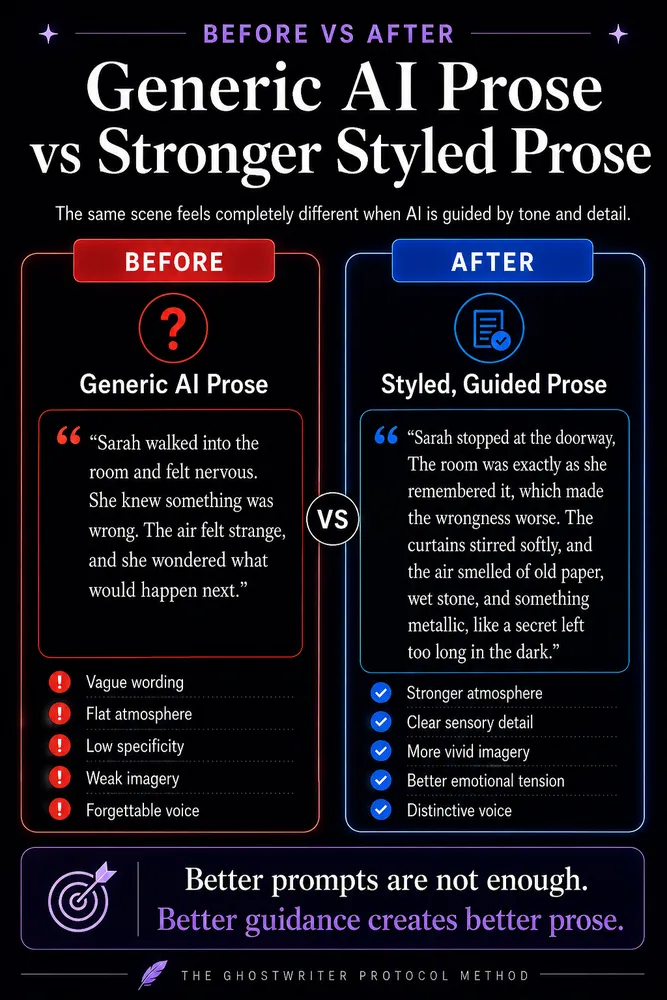
AI can write fast, but speed does not matter if the writing sounds generic.
This bonus helps you guide AI toward stronger style, tone, rhythm, emotional texture, and voice. It shows how to move beyond flat AI prose and create writing that feels more intentional, polished, and genre-aware.
This is especially valuable for fiction, memoir-style nonfiction, self-help books, storytelling essays, and author brands that need a distinct voice.
Example income opportunity:
You could offer a simple service: “AI Writing Style Upgrade for Authorsâ€. If you charge $49 per short manuscript sample or chapter review:
This bonus can support not only your own writing, but also a service offer for other AI authors.
Dialogue is one of the easiest places to spot weak AI writing.
This bonus helps you improve character conversations, emotional subtext, pacing, voice distinction, and dialogue purpose. Instead of letting every character sound the same, you learn how to guide AI toward more natural and character-driven dialogue.
Example income opportunity:
You could create a small product: “AI Dialogue Improvement Kit for Fiction Writersâ€. If sold for $12:
For fiction writers, better dialogue is a very specific and painful problem. Specific problems are easier to sell.
This bonus shows how AI-assisted writing can be turned into a service, not just a personal writing tool.
You’ll learn how to think about ghostwriting offers, book architecture, client workflows, AI-assisted outlining, manuscript development, and delivery systems.
This is useful if you want to help other people turn ideas into books using AI-supported workflows.
Example income opportunity:
If you offer a simple book outline service for $99:
If you offer a deeper AI-assisted book planning package for $299:
This bonus can help you turn the system into a service business.
A book does not only need words. It also needs a visual identity.
This bonus helps you understand how to use AI tools to create better book cover concepts, visual directions, layout ideas, genre cues, and prompt-based cover design workflows.
Even if you are not a designer, this can help you create stronger cover concepts for your own books or client projects.
Example income opportunity:
You could sell simple AI-generated cover concept packages for $29:
Even low-ticket cover concept offers can be attractive to indie authors who need affordable visual help.
This bonus expands the cover idea into a possible business model.
Instead of only creating covers for yourself, you can learn how to package AI-assisted cover design as a service: concept creation, style direction, niche cover packs, mockups, revision options, and client-facing offers.
Example income opportunity:
If you sell a basic cover concept package for $49:
If you sell a premium cover direction package for $99:
This bonus gives you another way to monetize the AI author market beyond writing alone.
Each bonus can help you create something useful:
That means this package is not only a writing system. It is also a library of possible products, services, and publishing assets you can build from.
One bonus idea used properly could potentially pay for the entire package.
A quick visual breakdown of how the Ghostwriter Protocol helps turn messy AI output into a more controlled writing process.
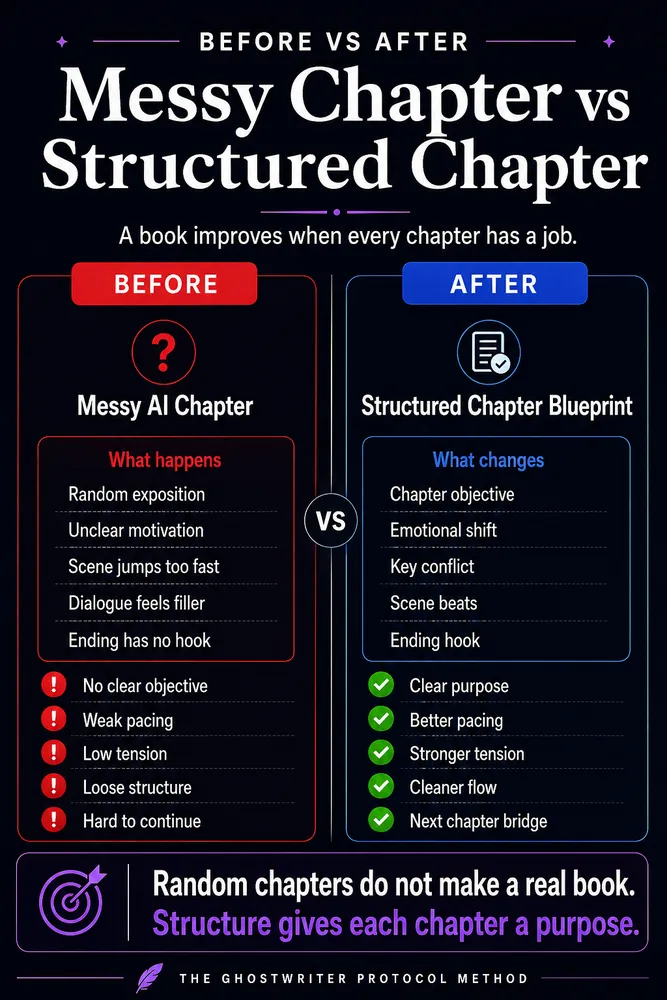
This is not just an ebook you read once and forget.
The Ghostwriter Protocol Method is designed to become part of your writing workflow - every time you plan a book, build a premise, outline chapters, revise AI output, improve dialogue, control style, or prepare a manuscript.
Many authors spend money on writing apps, AI tools, editing software, templates, courses, or plugins.
But tools alone do not solve the real problem.
If you do not know how to direct AI properly, even the best AI model can still produce messy chapters, generic prose, weak structure, and inconsistent drafts.
This system gives you the missing workflow behind the tools.
A single ghostwriter can cost hundreds or thousands of dollars for one project.
The Ghostwriter Protocol Method does not replace professional judgment, but it helps you use AI to plan, draft, revise, and improve your own books with more control.
Instead of paying once for one manuscript, you get a repeatable system you can use across multiple projects.
A messy AI-written book can waste weeks.
You may have to rewrite chapters, repair structure, fix repetitive sections, rebuild character consistency, or restart the entire draft.
This system is designed to reduce that chaos by helping you build the book correctly before the draft gets out of control.
A better workflow early can save a lot of cleanup later.
A prompt pack may give you things to copy and paste.
But once your book gets longer, disconnected prompts are not enough.
This package gives you a full method: idea, premise, structure, beats, drafting, revision, style control, nonfiction flow, dialogue improvement, and long-form consistency.
You are not buying random prompts. You are buying a reusable writing process.
The main system alone is 338 pages.
On top of that, you also get 9 bonus books with 760 bonus pages total, covering nonfiction, premise generation, writing style, dialogue, ghostwriting, production workflows, book covers, and AI-based publishing opportunities.
That means the package is not only about writing one book.
It can support multiple parts of your author workflow.
This system is model-independent.
It is not built around one temporary prompt trick or one specific AI tool.
As ChatGPT, Claude, Gemini, and future AI models improve, a strong writing workflow becomes even more useful.
The better AI gets, the more powerful a clear protocol becomes.
Simple answers to the biggest objections.
No. The Ghostwriter Protocol Method is not designed as a collection of disconnected prompts. A prompt pack usually gives you things to copy and paste, but it does not teach you how to build a full book from idea to manuscript. This system focuses on the workflow behind AI writing: premise, structure, chapter planning, scene beats, voice control, revision loops, and long-form consistency. You still get practical instructions, but the real value is learning how to direct AI through a repeatable book-building process.
If you already use AI to write, you are actually the ideal reader for this system. The problem many AI authors face is not access to AI — it is control. AI can generate text quickly, but without the right structure it can produce generic prose, messy chapters, inconsistent voice, and weak long-form flow. The Ghostwriter Protocol Method helps you use AI more strategically, so you are not just asking for text, but guiding the entire writing process from concept to revision.
No. This is not a “click one button and get a perfect book†promise. The system is built for authors who understand that good books still need direction, review, judgment, and editing. What the Protocol does is help reduce chaos by giving AI better instructions, clearer structure, stronger context, and revision steps. It can help you produce better drafts and improve your workflow, but you are still the author and final decision-maker.
Yes. Generic prose is one of the biggest problems this system is designed to address. Many AI drafts sound flat because the author only asks AI to “write in a good style†without giving it specific voice rules, tone direction, scene purpose, genre expectations, or revision criteria. The Protocol helps you give AI a clearer writing target so the output can become more intentional, more structured, and less like the usual generic AI text.
Yes. This is one of the core reasons the system exists. Many AI-written books start well, but after a few chapters the structure weakens, the tone changes, the characters drift, and the story or argument becomes messy. The Protocol is designed to help you build the book before drafting: idea, premise, structure, beats, continuity notes, and revision loops. That gives AI a stronger map to follow instead of forcing it to invent the book one chapter at a time.
Yes. The system can be applied to fiction because fiction needs more than fast chapter generation. It needs premise, character motivation, emotional arcs, world logic, scene purpose, dialogue control, pacing, continuity, and revision. The Ghostwriter Protocol Method helps you guide AI through those layers before drafting, so your story has a stronger foundation and the AI is less likely to lose track of what kind of book it is writing.
Yes. Nonfiction has different problems, but the system can still help. Many AI nonfiction drafts become repetitive, shallow, or too blog-like because they lack a clear teaching framework. The Protocol helps you define the reader problem, chapter promise, argument flow, examples, action steps, and transformation path before drafting. This can help AI create nonfiction that feels more organized, useful, and reader-focused instead of just producing long generic paragraphs.
Yes. Weak books often begin with weak premises. If the idea is too vague, AI will usually produce vague output. The system helps you strengthen the idea before writing by clarifying the hook, conflict, reader promise, genre direction, emotional engine, or teaching angle. This is useful for fiction authors who need stronger story concepts and nonfiction authors who need clearer positioning before building the book.
It can help, especially if your writer’s block comes from not knowing what to do next. The Protocol breaks the writing process into smaller stages, so you are not staring at a blank page asking AI to magically solve everything. Instead, you move through idea, premise, structure, beats, draft, and revision. This gives you a clearer next step and makes AI more useful as a thinking partner, not just a text generator.
Yes. Style drift happens when AI starts writing in one voice, then slowly changes tone, pacing, vocabulary, or emotional texture across chapters. The Protocol helps by encouraging the use of style rules, voice direction, tone guidelines, genre expectations, and revision checks. It does not guarantee perfect consistency, but it gives you a practical way to reduce random shifts and keep the book closer to the intended voice.
Yes. Character inconsistency is common in AI fiction because AI may forget how a character speaks, reacts, fears, desires, or changes over time. The system helps you create character control materials before drafting, such as motivation, emotional wounds, speaking style, relationship tension, decision patterns, and things the character would or would not do. This gives AI stronger reference points so characters are less likely to feel random from chapter to chapter.
Yes. AI dialogue often sounds too direct, too polite, too repetitive, or too similar between characters. The Protocol helps you think about dialogue as part of story movement, not just conversation. By giving AI character voice rules, relationship context, emotional subtext, scene tension, and purpose, you can guide it toward dialogue that better reflects the character and the situation.
Yes. Repetition is one of the most common problems in AI nonfiction. It usually happens because AI is asked to write chapters without a clear chapter thesis, teaching sequence, or progression of ideas. The Protocol helps each chapter serve a specific role in the reader journey, so chapter one, chapter two, and chapter three are not just different versions of the same advice. This makes the nonfiction manuscript easier to organize and improve.
Yes. The system does not treat AI as only a drafting tool. It also teaches you to use AI as part of the revision process. That means AI can help audit a chapter, identify weak structure, detect repetition, check continuity, improve transitions, strengthen voice, and suggest better versions. You still need to review the changes, but the goal is to make AI help with cleanup instead of leaving all the repair work to you.
No advanced coding or technical skill is required. However, this is not meant for someone who has never used AI before. You should already be comfortable using tools like ChatGPT, Claude, Gemini, or similar AI writing tools. The system is more about thinking, structuring, prompting, and revising than technical setup. If you already know how to chat with AI and want better writing results, the material should be understandable.
Not really. A complete beginner may still benefit from some ideas, but the product is mainly built for people who already use AI for writing and want to improve their results. If someone does not know what an AI writing tool is, has never tested prompts, and has no experience generating text with AI, this may feel too advanced as a first AI product. It is better suited for authors who already know the pain of messy AI output.
Yes. The system is designed to be model-independent. It is not built around one specific AI model or one temporary prompt trick. The core idea is to improve how you guide AI through the writing process. That means the workflow can be adapted to ChatGPT, Claude, Gemini, and future AI tools, as long as the tool is capable of long-form reasoning, instruction following, drafting, and revision.
Yes. In fact, the system is designed around the idea that better AI models make a strong workflow even more useful. If AI becomes more capable, then giving it better structure, clearer context, stronger revision instructions, and a more organized writing process becomes even more powerful. The Protocol is not about exploiting one current AI weakness. It is about learning how to direct AI as a long-form writing partner.
No. KDP authors can use it, but the system is not limited to Amazon publishing. It can be used by AI authors, indie authors, self-publishers, ghostwriters, nonfiction creators, fiction writers, digital product sellers, and anyone building book-length content with AI. The focus is on creating better books and writing workflows, not on one specific publishing platform.
Yes. The system can be used for short ebooks because even short books need structure, clarity, and revision. In fact, a shorter ebook can be a good place to apply the Protocol because you can practice the workflow faster. You can use the system to clarify the idea, build the outline, create chapter points, draft sections, and revise the final document without needing to start with a massive manuscript.
Yes. The system is especially useful for longer projects because long-form writing is where AI often becomes messy. A full-length book requires stronger planning, continuity management, chapter purpose, style control, and revision. The Protocol gives you a way to break the project into manageable stages so AI is not forced to invent and remember everything at once.
Yes. The Protocol can support series planning because it emphasizes continuity, character control, premise development, and repeatable workflows. For fiction series, this can help with world rules, character arcs, unresolved threads, and future setup. For nonfiction series, it can help create consistent structure, reader promise, and content architecture across multiple books.
It can help you write more efficiently, but the main goal is not just speed. Writing faster is not useful if the result is weak, generic, or unusable. The Protocol is designed to help you reduce wasted time by building a better structure before drafting and using AI more effectively during revision. In practice, a clearer system can make the process faster because you spend less time fixing chaos later.
No. It can help with revision, but it does not remove the need for human judgment. AI can help identify problems, suggest improvements, and rewrite sections, but the author still needs to decide what belongs in the final manuscript. Think of the Protocol as a way to make AI a better assistant in the editing process, not as a replacement for taste, judgment, or final review.
Yes. If you already own prompt books, this system can still be useful because it gives you a way to organize and use prompts inside a bigger workflow. Many prompt books tell you what to ask. The Ghostwriter Protocol focuses on when to ask, why to ask, what context to provide, how to connect outputs, and how to revise the result. It can make your existing prompts more useful because you are no longer using them randomly.
It is designed to be practical. The main goal is not to discuss AI writing in an abstract way, but to help you understand and apply a repeatable writing workflow. The system explains how to move from idea to premise, structure, beats, drafting, and revision. It also includes bonus materials and examples that help show how the process can be applied to fiction, nonfiction, writing style, dialogue, book covers, and production workflows.
Yes. While the main focus is writing better books with AI, several bonuses can help you turn the workflow into products or services. For example, you could create nonfiction ebooks, premise packs, prompt templates, dialogue improvement kits, book outline services, AI-assisted ghostwriting offers, or cover concept packages. No income is guaranteed, but the bonuses are designed to give you practical directions for monetizing AI-assisted writing skills.
You can ask AI to make better prompts, but that alone is not a complete writing system. A better prompt may improve one output, but a book needs a sequence of decisions: premise, structure, chapter purpose, continuity, style, draft, revision, and assembly. The Protocol teaches you how to make AI participate in that larger process. It is not just about better prompts; it is about better workflow control.
Free videos can be useful, but they are often scattered, incomplete, or focused on one trick at a time. The Ghostwriter Protocol Method is organized as a complete system for AI-assisted book creation. Instead of jumping between random tips, you get a structured approach that connects idea development, outlining, chapter planning, style control, revision, and long-form manuscript building.
You can still use the system. Not every author wants to build a publishing business or sell books immediately. Some writers simply want to finish a personal book, improve their fiction, organize nonfiction ideas, or learn how to use AI more intelligently. The Protocol is useful because it helps you think and write with more structure, even if your goal is not commercial publishing right now.
No. The 30% discount is positioned as a limited-time launch offer. If the discount is active, you can use the code shown on the page during checkout. Once the offer ends, the price may return to the standard price. The final checkout section includes the current discount reminder and timer so you can decide before the launch window closes.
You get access to the main 338-page Ghostwriter Protocol Method ebook and the included bonus materials. The package is designed to give you both the main system and supporting resources for nonfiction, production workflows, premise generation, style, dialogue, ghostwriting, book covers, and AI-based publishing ideas. You can start by reading the main ebook or jump into the bonus that matches your current writing problem.
If you are already using AI to write but your drafts still feel messy, repetitive, shallow, or inconsistent, this protocol gives you a structured way to turn AI into a serious long-form writing partner.
This limited launch window is closing soon. Use code 30OFF before the timer ends to get the current discount.